The Complete Guide to Adjustable Trailer Hitches
Share article
An adjustable trailer hitch is a type of ball mount that lets you raise or lower the hitch height so your trailer stays level while towing. This adjustability improves stability, reduces trailer sway, and helps ensure safer, more controlled handling on the road.
Unlike a fixed ball mount, an adjustable hitch can be quickly repositioned to match different trailer heights. That means you can use one hitch across multiple trailers and vehicles without sacrificing performance or safety.
In simple terms: it’s a more flexible, more precise way to tow.
Whether you’re hauling a utility trailer, boat, or camper, keeping your trailer level is one of the most important factors for safe towing. An adjustable hitch makes that easy by allowing fast height changes, better weight distribution, and a more dialed-in connection every time you hook up.
In this guide, we’ll cover everything you need to know about adjustable trailer hitches: what an adjustable hitch actually is, the parts that make up the hitch, how the hitch works, how to use it, the pros and cons, how it compares to other options, and which one to buy.
What is an Adjustable Trailer Hitch?
An adjustable hitch is a type of ball mount that can be adjusted up or down to promote level towing. The tongue portion is attached to a vertical channel or shank. The tongue can be set higher to level out a high-riding trailer, or it can be lowered to accommodate a trailer that rides closer to the road. This unique ability ensures that whichever trailer you’re pulling, it rides level.
This is an adjustable receiver hitch:

Level towing – that is, making sure the trailer frame is parallel to the road – is important for safety, driver control and deterring trailer sway. A trailer that’s pitched too far forward or backward can lead to unsafe towing situations.
Adjustable trailer hitches (a.k.a. an adjustable ball mount or adjustable receiver hitch) are a versatile and powerful solution to this problem. They come in all sorts of shapes, sizes and capacities, as well as different material options, including steel and aluminum. Some are rated for as much as 20,000+ pounds with a vertical adjustment span of 18 inches or more. Others are compact, lightweight and built for fast, nimble adaptation.
Some different types of adjustable trailer hitches:
Every trailer you tow should be leveled for safety and to reduce wear and tear on both the trailer and the tow vehicle. In order to achieve level towing for multiple trailers, an adjustable hitch provides an adaptable, multi-fit solution. Unlike a fixed ball mount, you can change the tow height simply by moving the tongue up or down.
Adjustable hitches not only offer flexibility for level towing; they also accommodate a variety of coupler styles. Some have dual balls to hook up to two different size trailer couplers. Others have a pintle hook or standard ball mount tongue. You can also choose from a number of design features, such as integrated anti-rattle, different shank sizes, and shock-absorbing technology.
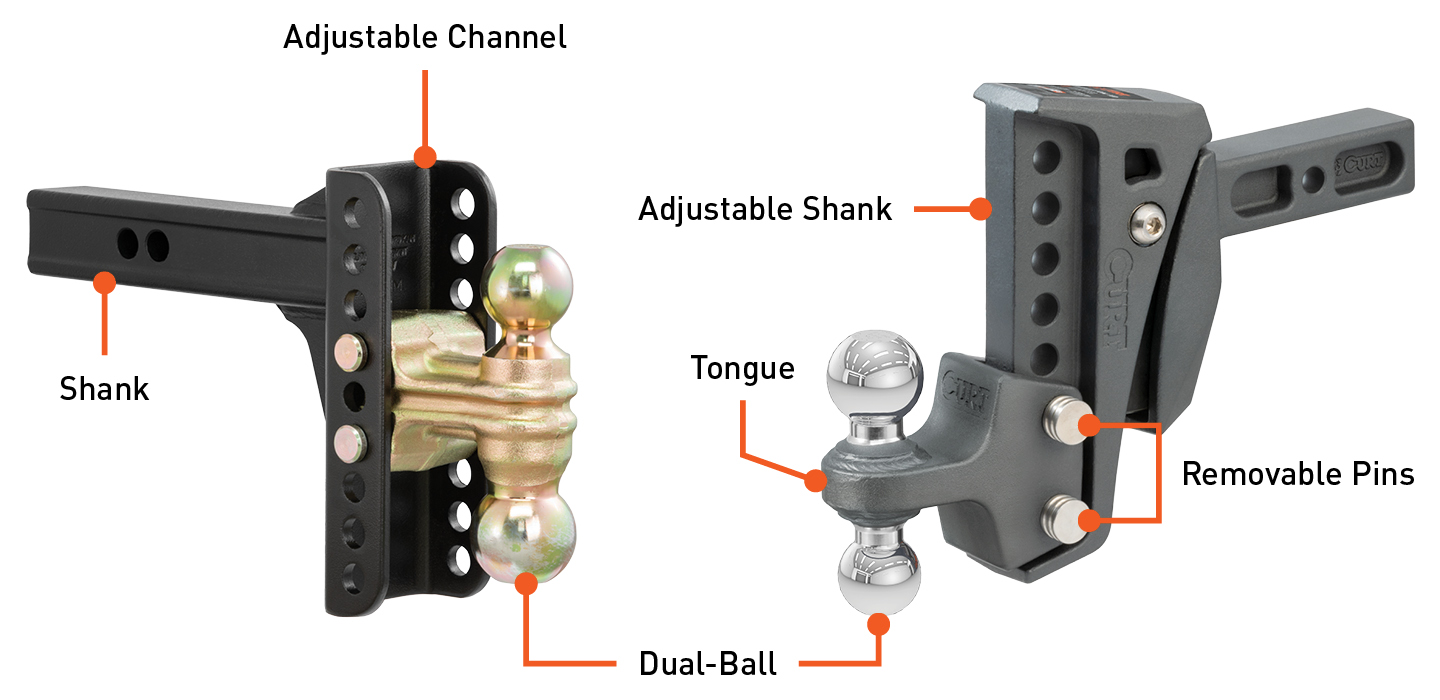
Adjustable Channel or Shank
The adjustable channel or shank, depending on the model, is the vertical component that allows the coupling attachment (i.e. the tongue) to be adjusted up or down. This is the key element that gives the hitch its adaptable characteristic.
Shank
The shank is the tube or bar that inserts into the hitch receiver tube on your tow vehicle. This primary shank sits in the horizontal position, perpendicular to the vertical shank or channel.
Tongue
The tongue provides a mounting point for the trailer ball(s), and it is the component that moves up or down for height adjustment.
Dual Ball
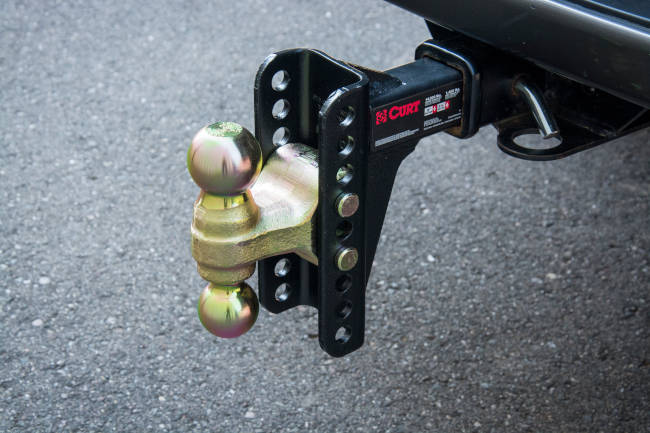
A dual ball is the connection point between your vehicle and trailer. The advantage of a dual trailer ball is that it is reversible to accommodate different size couplers, featuring two different ball diameters. In place of a dual ball, some adjustable hitches come with a pintle hook or standard tongue.
Removable Pins
Removable hitch pins pass through the tongue attachment and vertical channel or shank, securing everything in place. To make quick height adjustments, the pins can be removed and replaced with ease.
How Does an Adjustable Hitch Work?
An adjustable hitch is all about adaptability. It is meant to be a faster, easier solution compared to owning multiple fixed ball mounts.
Let’s say it’s Saturday, and you’re planning to make a trip to the dump. Your utility trailer is filled up with brush and other yard waste, and because it’s a smaller trailer, it rides lower to ground. It also has a 2” coupler. With your adjustable hitch secured into the receiver tube of your vehicle, you set the dual ball at a 3” drop with the 2” diameter ball facing up. You hook up, and away you go.
After returning from the dump, it’s time to take the family out on the boat. Unlike your utility trailer, your boat trailer rides higher up, and it has a 2-5/16” coupler. No problem! After a quick flip of the dual-ball – this time with the 2-5/16” ball facing up – and an increase in height for a 2” rise, you’re ready to head to the boat landing.
With an adjustable receiver hitch, there’s no need for separate ball mounts or trailer balls. You just need one hitch. It’s easier to store and faster to use. The dual ball can accommodate different trailers while still maintaining level towing and a safer experience.
How to Use an Adjustable Hitch
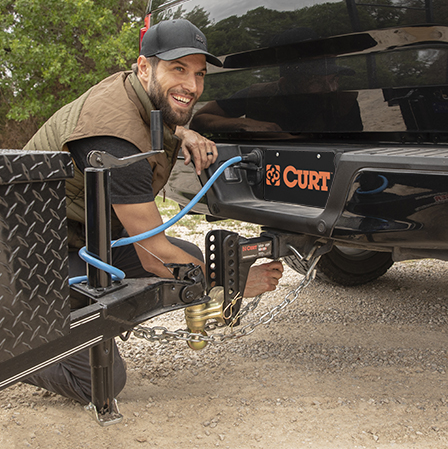
One of the keys to level towing is finding the proper ball height, and adjustable hitches offer a much simpler and easier solution compared to other options. Unlike a standard, fixed ball mount that requires tedious calculations up front, an adjustable hitch adapts to any ball height needed in three quick steps.
Before you begin, make sure your trailer is parked on a level surface and that it’s sitting parallel with the ground.
Step 1: Install the Shank
Insert the horizontal shank of the adjustable hitch into the receiver tube on your tow vehicle. Secure it with a pin and clip.
Step 2: Measure the coupler height
Using a measuring tape, measure from the bottom of the trailer tongue or coupler to the ground.
Step 3: Set your adjustable hitch height
Using your tape measure again, find the hole in the vertical shank closest to the coupler height. This will be the location for the top pin on your dual ball attachment. Insert both pins to secure the attachment, and you’re ready to hitch up your trailer.
Adjustable Trailer Hitch Diagram — How to Set Up Your Hitch & Take Measurements

Note that if the coupler height exceeds the limits of the vertical shank, you may be able to flip the shank over in the receiver. Not all adjustable hitches have this capability. Verify the ratings of your particular hitch before use. Depending on trailer height and load weight, you may actually need an adjustable hitch riser, meaning the trailer hitch is set to a higher notch than the standard trailer hitch height. If towing with a large, tall truck or a truck with a lift, it's likely you will need to know how to measure trailer hitch drop correctly. See the adjustable hitch diagram above for each individual part and watch the video for guidance. Be careful to measure hitch drop and hitch ball height correctly, as getting the proper trailer hitch height correct is important and it will impact handling while towing.
Advantages of the Adjustable Hitch
The biggest advantage that an adjustable trailer hitch has over other types of hitch ball mounts is its one-size-fits-all approach. Instead of requiring you to buy, maintain, store, keep track of, swap out, etc. several different ball mounts, an adjustable hitch is all you need. If you choose the right one, you can tow all of your trailers as needed with much less hassle.
Pros & Cons of Adjustable Receiver Hitches
Pros
- Ability to tow multiple trailers
- Easily adjusted to level any trailer
- Less storage space required compared to owning multiple mounts
- Multiple ball sizes
- Integrated anti-rattle and shock-absorbing tech available
- Multiple attachments / accessory options
Cons
- More of an investment up front
- Typically heavier than basic, fixed ball mounts
- Some setup / configuration required
Adjustable Hitches Compared to Other Types
Adjustable Hitch vs. Fixed Ball Mount
Obviously, one of the greatest advantages an adjustable hitch ball mount has over a fixed ball mount is its versatility. As the name suggests, a fixed ball mount (or standard ball mount) is comprised of a single welded or forged piece of metal. At its core, there are no moving parts. This means that a fixed ball mount can only offer one level of drop or rise (some are able to be flipped, offering one drop and one rise option each). This becomes very restrictive for multi-trailer owners.
An adjustable ball mount really is the superior option. It not only adapts to various trailer heights, but the dual ball that is equipped on so many models is much faster and easier to use. While a fixed ball mount typically requires a fair amount of wrenching and torquing to swap out trailer ball sizes, an adjustable dual ball simply needs to be flipped over.

Adjustable Trailer Hitch vs. Multi-Fit Receiver Hitch
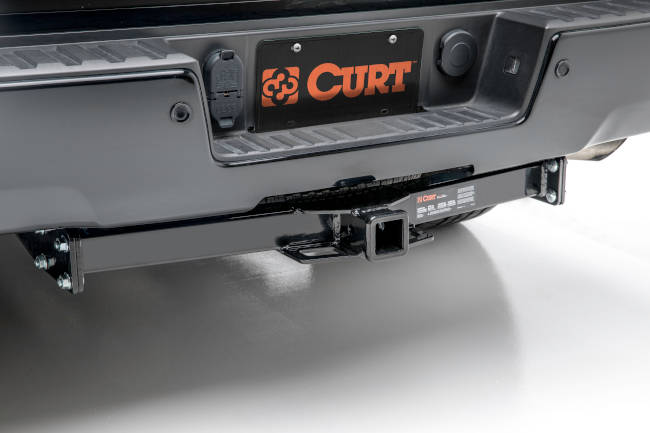
Just like the word “hitch” sometimes refers to the ball mount portion of the towing connection and other times to the receiver component, “adjustable trailer hitch” can have two different meanings. Sometimes when people say, “adjustable trailer hitch,” they are referring to a proper adjustable receiver hitch ball mount. Other times, they may call them multi-fit receiver hitches. Sometimes these hitches can also be called "adjustable ball hitch" or "adjustable drop hitch" as well. Overall, they mean the same thing.
Multi-Fit Receiver Hitch
Let’s start by defining what a multi-fit receiver hitch is. First, this type of hitch is strictly a receiver, the vehicle-side of the connection and the portion of the system that bolts onto the vehicle’s frame. As the name implies, a multi-fit hitch is designed to fit multiple vehicle makes and models. Some multi-fit hitches have an adjustable frame that slides in or out to adapt to the frame width as needed. Because of this adjustable design, multi-fit receiver hitches are sometimes referred to as ”adjustable trailer hitches.”
Adjustable Trailer Hitch Ball Mount
An adjustable receiver hitch ball mount is really an accessory to the receiver hitch. It can be referred to simply as a “hitch”, but it is meant to be installed into the receiver tube and serves as the connection point for the trailer. Because adjustable hitches are often multipurpose in nature, they are often referred to as “multi-fit hitches.”
How to Choose the Best Adjustable Hitch for Your Setup
If you want to buy the right adjustable hitch (that is, a proper adjustable ball mount), you need to select one that fits all of your trailers – boat, camper, utility trailer, etc. You also need to ensure that it’s a good fit for your vehicle. Generally, adjustable receiver hitches are reserved for larger vehicles, such as pickup trucks, 4x4s, SUVs and full-size vans.
Adjustable Hitch Selection Checklist
Consider the following guidelines when shopping for the best adjustable hitch to suit your needs.
1. Don't exceed your towing capacity
Your vehicle and towing equipment may be rated for different weight capacities. Likewise, the various trailers you’re planning to tow will range in gross trailer weight (GTW). Be sure to select a hitch that complements your other towing equipment and exceeds the weight of your trailer(s) in capacity. You don’t want your adjustable hitch limiting your towing potential, and you should never exceed the weight capacity of any towing component.
2. Match your receiver size
The horizontal shank of your adjustable hitch needs to be an exact match for your vehicle’s rear receiver tube. Most are designed with standard sizes, likely narrowing your choices down to 2” or 2-1/2".
3. Make sure the ball and coupler sizes are compatible
It’s important to know the coupler sizes of all of your trailers before purchasing an adjustable hitch. Some adjustable hitches come with one ball, others with two, and still others with three. If you have multiple coupler sizes in your fleet, be sure to choose a hitch that will accommodate. Also note that pintle hook options are available if you are towing a trailer with a lunette ring.
4. Determine your height adjustment range
Following the steps above for measuring your hitch height, estimate how much height adjustment you’ll need. You’ll need to select an adjustable hitch that makes up the difference between your receiver hitch height, your “tallest” trailer and your “shortest” trailer. The process below provides a step-by-step guide.
Measuring for the Right Adjustable Hitch
To be effective, an adjustable ball hitch, or adjustable drop hitch, needs to make up the height difference between all of your trailers. With some quick measurements, you can be confident that you’re choosing the best one to suit your needs.
First, measure the coupler height of each of your trailers, taking note of the highest or tallest one, as well as the lowest or shortest one (i.e. the one that rides closest to the ground. Be sure to measure at the coupling point and that each trailer frame is resting parallel to the ground. The tallest trailer will be the top of your adjustment range and the shortest will be the bottom.
Next, measure the height of your vehicle’s receiver hitch, measuring from the top inside edge of the receiver tube.
Finally, calculate the difference between the receiver hitch height and the adjustment range extremes. When shopping for an adjustable hitch, make sure the max rise is greater than or equal to your receiver height versus your tallest trailer. Additionally, make sure that the max drop is greater than or equal to your receiver height versus shortest trailer.
Let’s walk through an example.
Adjustable Hitch Measuring Example
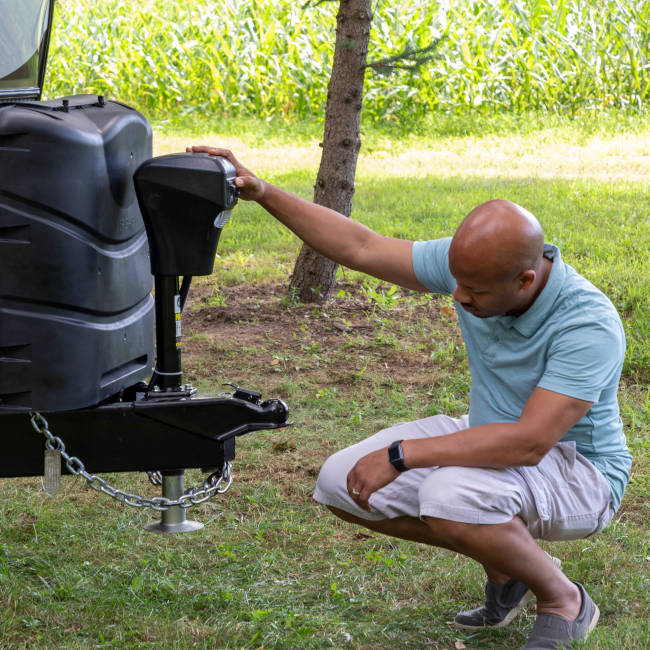
Let’s say you own three different trailers: a travel trailer, a jetski trailer and an open utility trailer. After measuring the coupler heights of all three, you discover that the travel trailer rides the lowest at 15” and the jetski trailer rides highest at 22”. Then, you measure the height of your receiver hitch at 19”.
To choose the right adjustable hitch, you’ll need to calculate the differences (the drop and rise).
15” vs. 19” vs. 22”
Let's do some simple math.
- Max drop required: Travel trailer height (15”) minus receiver height (19”) = -4” drop
- Max rise required: Jetski trailer height (22”) minus receiver height (19”) = 2” rise
The CURT adjustable channel mount #45900 has an adjustment range with a 6” drop all the way up to a 5-1/4" rise. Because the drop is greater than what’s required for your travel trailer (6 > 4), and because the rise exceeds what’s required for your jetski trailer (5-1/4 > 2), this adjustable hitch would be a great choice.
Remember to also consider weight capacity, ball size and receiver tube size before purchase!

More about Hitch Drop & Rise - A Quick Primer
If hitch drop and rise are completely unfamiliar terms, you may be feeling a little lost.
No worries!
The video below offers a helpful tutorial on the subject. Even though the products used in the video are standard, fixed ball mounts, the principles still apply to adjustable varieties.
Just remember, drop and rise are all about the height differences between your vehicle’s hitch receiver and your trailer’s coupler. If the trailer rides lower than the vehicle, this indicates drop. If the trailer rides higher, this indicates rise.
The greater the height difference between the receiver and coupler (i.e. vehicle and trailer), the more drop or rise needed. An adjustable ball mount not only accommodates for this height difference, but it can also be fine-tuned for varying heights with different vehicle-trailer combinations.
Who Should Use an Adjustable Trailer Hitch?
An adjustable trailer hitch is especially useful for drivers who tow multiple trailers or regularly switch between different loads. Because trailer coupler heights can vary significantly, an adjustable hitch helps maintain a level towing setup without needing multiple fixed ball mounts.
Adjustable hitches are commonly used by:
- RV owners towing travel trailers or campers
- Contractors hauling equipment trailers
- Truck owners with lifted or oversized vehicles
- Drivers towing utility, cargo, boat, or landscape trailers
- Families using multiple recreational trailers throughout the year
For anyone towing more than one type of trailer, an adjustable hitch offers added flexibility, convenience, and improved towing control.
When Should You Use an Adjustable Trailer Hitch?
An adjustable trailer hitch isn’t just a convenience upgrade. In many cases, it’s the simplest way to solve real towing problems.
You should consider using one if:
- You tow multiple trailers with different coupler heights
- Your vehicle has a lift kit, oversized tires, or suspension changes
- You switch between different tow vehicles
- Your current setup causes trailer tilt, sway, or uneven wear
The key benefit is flexibility. Instead of forcing your setup to work with a fixed height, an adjustable hitch lets you match your equipment to the situation. That’s what keeps your trailer level and your towing predictable.
Common Mistakes Adjustable Hitches Help Prevent
One of the easiest ways to improve towing safety is simply getting your setup level. Adjustable hitches help prevent a few common issues:
1. Nose-Up or Nose-Down Towing
If your trailer isn’t level, weight distribution shifts. That can impact braking, steering, and stability.
2. Trailer Sway at Speed
An unbalanced trailer is more likely to sway, especially at highway speeds or in crosswinds.
3. Uneven Tire Wear
Improper angles can cause one axle or tire set to carry more load than intended.
4. Extra Stress on Equipment
A poor hitch height puts added strain on the coupler, frame, and suspension components.
An adjustable hitch gives you a simple way to correct all of these by dialing in the right height before you hit the road.
Common Accessories for an Adjustable Hitch
Adjustable hitches do more than add flexibility for trailer height. There are many different accessories for different types of towing and beyond.
Frequently Asked Questions About Adjustable Trailer Hitches
-
What is an adjustable trailer hitch?
An adjustable trailer hitch is a type of ball mount that allows you to raise or lower the hitch height to keep your trailer level while towing. This adjustability helps ensure safer handling, better control, and reduced trailer sway.
-
Why is it important to tow a trailer level?
Level towing keeps the trailer frame parallel to the road, which improves stability, braking, and overall control. An unlevel trailer can cause sway, uneven tire wear, and added stress on both the trailer and tow vehicle.
-
How does an adjustable hitch work?
The hitch allows you to slide the ball mount up or down along a vertical channel and secure it in place with pins. This lets you quickly match the hitch height to different trailers without needing multiple ball mounts.
-
Can one adjustable hitch work with multiple trailers?
Yes, that’s one of the biggest advantages. You can easily adjust the height and, in some cases, switch between different ball sizes, making it a versatile solution for towing multiple trailers.
-
Are adjustable hitches better than fixed ball mounts?
Adjustable hitches offer more flexibility and convenience, especially if you tow different trailers. Fixed ball mounts are simpler and often less expensive, but they only provide one height setting, which can limit usability.
-
Are adjustable trailer hitches safe?
Yes, when properly rated and installed. Always ensure your hitch meets or exceeds your trailer’s weight requirements and that all pins, clips, and connections are securely fastened before towing.
-
Do I need an adjustable hitch for my vehicle?
If you tow multiple trailers, switch vehicles, or struggle to keep your trailer level, an adjustable hitch is a smart upgrade. It’s especially useful for trucks, SUVs, and other vehicles with varying hitch heights
These photographs, recommendations, and approximations are intended for demonstration purposes only and do not reflect the specifications of any particular hitch, tow vehicle, recreational vehicle or trailer. Always consult the manufacturer’s owner’s manual.