RV Awning Parts Diagram with Definitions
Share article
RV awning parts work together to provide shade, stability, and smooth operation, but identifying each component can be challenging without a clear reference. This guide breaks down the essential parts of an RV awning, explains how they function, and provides diagrams to help you quickly recognize what you have and what you need. Use it to make informed decisions when repairing, replacing, or upgrading your awning system.
Whether your camper needs an awning installed or your RV needs a replacement awning, you’ll want to know exactly what you need to buy and how parts for camper awnings fit together. The following RV awning parts diagrams, terms and definitions will help guide you to make an educated decision when you’re in the process of buying a new shade solution for your rig.
What are the Parts of an RV Awning Called?
RV awning parts include structural components like the awning rail, roll tube, and support arms, along with operational elements such as the drive arm, motor or spring system, and control features. The exact parts vary based on whether the awning is manual, electric, or hybrid.
Your RV can have a few different configurations when it comes to awnings. The parts of an RV awning largely depend on the type of awning you currently have or aspire to have. You can buy manual style awnings, electronic awnings or a mix of both, which are called hybrid awnings. Not all shade solutions are alike; therefore, some awnings may not have all the parts listed in the definitions below.

Awning Rail
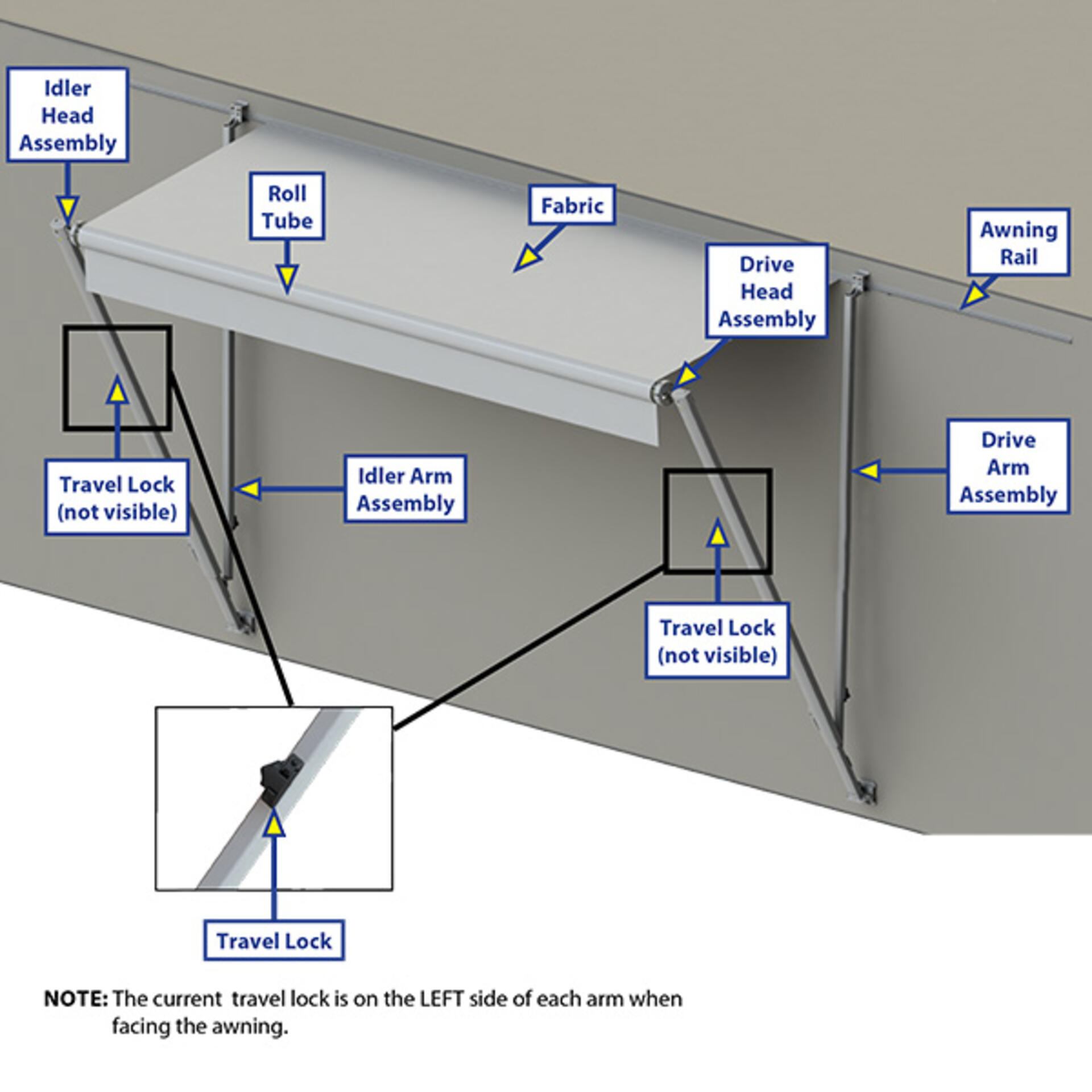
The awning rail is a continuous piece of metal that is mounted to an RV wall before the awning is installed. There is a polycord sewn into the awning fabric that fits a channel in the awning rail to retain and support the fabric connection to the coach.
Drive Arm Assembly
The drive arm assembly provides the wall-mount structure to hold the awning to a coach. It has an adjustable length to adapt the awning to different size RV models.
Drive Head Assembly
The drive head is the part on the end of the roll tube that helps you extend and retract your awning easily, either through a spring or a motor, depending on your awning model.
- A manual awning contains a torsion spring that puts the whole roll tube under tension. This spring load effect must be overcome by force when opening the awning manually and creates the return force to retract the roll tube and arms to the wall when closing.
- A powered awning contains a DC motor that rotates the roll tube to move the awning to an open or closed position. It has a manual override access port where you can insert a common drill with a bolt driver bit to open or close the awning in the event of motor failure.
End Cap
The end cap is the component that joins the roll tube to the motor within the drive head assembly.
Fabric
The awning fabric is the material that makes up the awning and provides shade. If you use your RV often, you’ll need to buy RV awning replacement fabric every few years to keep your rig looking fresh and new.
Idler Arm Assembly
The idler arm is on the idler side of the awning and assists in guiding the awning in and out. It has the same function as the drive arm assembly.
Idler Head Assembly
The idler head provides support for the roller tube and holds it in place parallel to the drive head assembly. It guides the awning as it opens and closes.
IR Sensor
The infrared security sensor detects body heat and motion to trigger your awning lights to illuminate.
Manual Crank Handle
The crank handle is the part on a hybrid awning drive arm that you turn to extend and retract your awning.
Pull Strap
The pull strap is a strip of material attached to the awning fabric that you pull on to extend and retract your manual awning.
Roll Tube
The roll tube provides a structure for the awning fabric to wrap around in the closed and closing positions.
Smart Arm Touchpad
The Smart Arm touchpad is the controller and electronic pad assembly that allows you to control the various functions of your awning, including extension and retraction, awning lights and wind sensitivity.
Support Arm Assembly
The support arm assembly is the metal structure that provides support to your awning roll and canopy throughout all open and close positions. The support arm assembly is the same on the drive side and idler side for a power awning. Within this assembly, you can have the following parts:
- Gas Strut — A device that uses gas pressure to provide a push or pull force that easily allows you to control the weight and motion of the awning when you extend or retract it.
- Inner Arm — The metal piece that extends from the wall mount to the outer arm.
- Outer Arm — The outermost metal piece of the awning that connects to the drive arm.
- Pitch Arm — The piece that helps you adjust the pitch, or angle, of the awning.
- Wall Mount — The metal piece that attached to the side of an RV.

Travel Locks
A travel lock is a manually pivoted bracing device that secures the arms in a closed position, so the awning is secure at high travel speeds.
Wind Sensor
A wind sensor is a device that detects wind speeds and automatically retracts your awning to avoid damage.
Wire Connector
The wire connector is the part that creates an electrical connection to your awning.
RV Awning Parts Diagrams
Now that you've brushed up on your awning terminology, we'll walk you through what different types of awnings look like. The awning diagrams below represent a few of the many options you have when purchasing a new RV awning. Each awning is built differently, depending on if it is a manual, electric or hybrid model.
Classic RV Awning with Travel Locks
Pull-Strap-Style Manual RV Awning
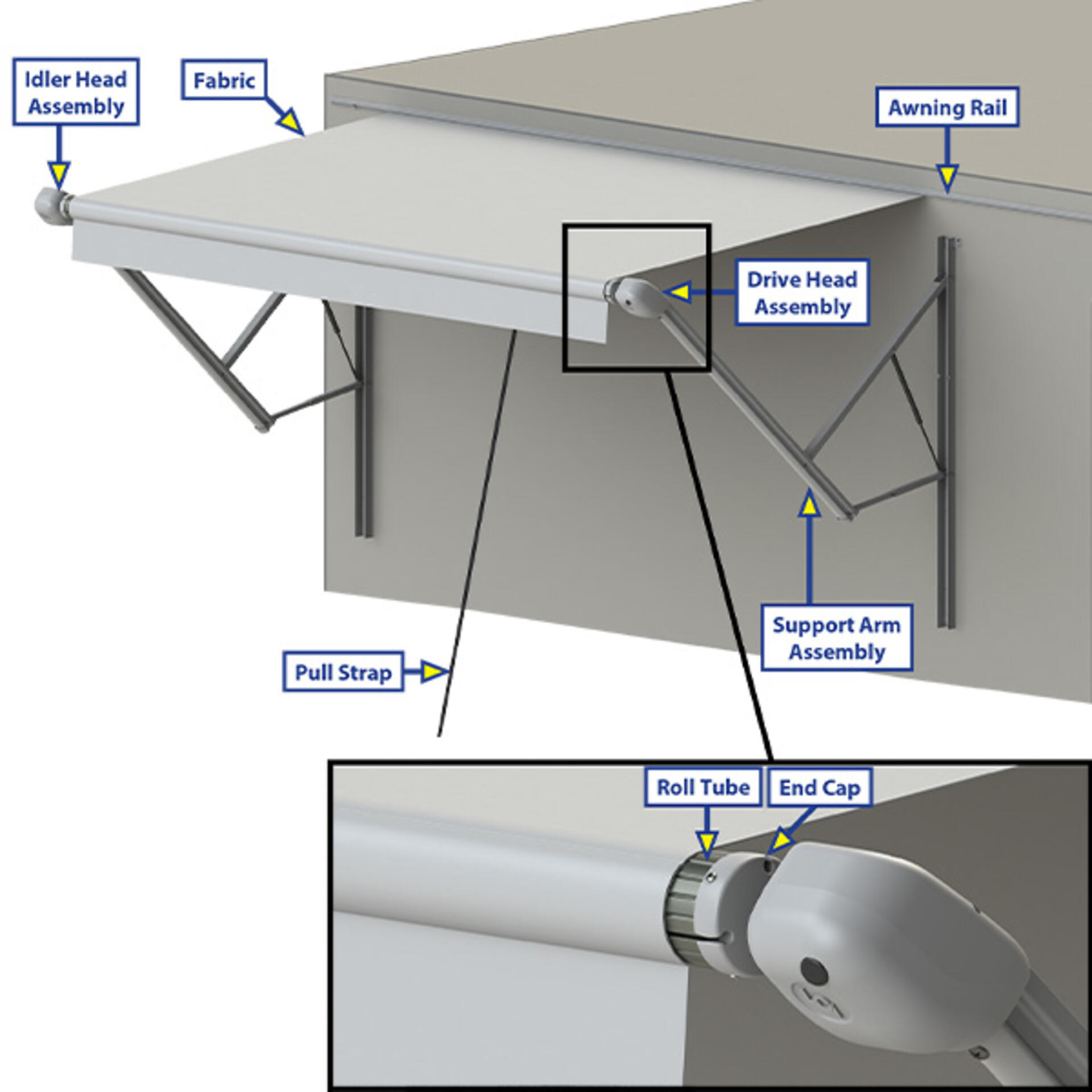
Hybrid-Style RV Awning


Common RV Awning Problems and What They Mean
Understanding how your awning components function also makes it easier to diagnose issues. Here are a few common problems and what they typically indicate:
- Awning won’t extend or retract: This may point to a faulty motor, damaged drive head, or electrical connection issue.
- Fabric sagging or pooling water: Often caused by improper pitch adjustment or worn support arms.
- Uneven extension: This can indicate misalignment between the drive arm and idler arm assemblies.
- Unusual noises during operation: Grinding or clicking may signal internal wear in the roll tube or motor.
- Awning retracts unexpectedly: A malfunctioning wind sensor or control system could be triggering automatic retraction.
How to Identify Your Current RV Awning
If you’re unsure what type of awning your RV currently has, and it’s equipped with a Solera® branded universal shade solution, watch the following video to easily identify your awning style.
Looking for RV Awning Replacement Parts and Fabric?
If you’re looking to upgrade your awning, we’ve got you covered! You can shop our large selection of RV awning replacement parts and awning replacement fabric to find the perfect upgrades for your RV aesthetic and style.
FAQs About RV Awning Parts
-
What are the main parts of an RV awning?
The main parts of an RV awning include the awning rail, roll tube, fabric, drive arm assembly, idler arm assembly, and support arms. Additional components like the drive head, motor, sensors, and control systems vary depending on whether the awning is manual or powered.
-
What does the roll tube do on an RV awning?
The roll tube is the cylindrical component that the awning fabric wraps around when retracting. It provides structure, keeps the fabric aligned, and enables smooth extension and retraction.
-
How do I know if I have a manual or electric RV awning?
Manual awnings require a pull strap or crank handle to extend and retract, while electric awnings use a motor controlled by a switch or touchpad. If your awning operates with a button or remote, it is powered.
-
What is the difference between a drive arm and an idler arm?
The drive arm contains the motor or spring mechanism that powers the awning’s movement. The idler arm sits on the opposite side and stabilizes the system, helping guide the awning during operation.
-
How often should RV awning fabric be replaced?
RV awning fabric typically needs replacement every three to five years, depending on usage, sun exposure, and weather conditions. Signs of wear include fading, cracking, or tearing.
-
Can I replace individual RV awning parts instead of the whole system?
Yes, many RV awning components such as fabric, arms, motors, and sensors can be replaced individually. Identifying the correct part depends on your awning type and model.
-
What is an RV awning rail?
An awning rail is a mounted track on the side of the RV that secures the awning fabric using a polycord. It serves as the anchor point for the entire awning system.